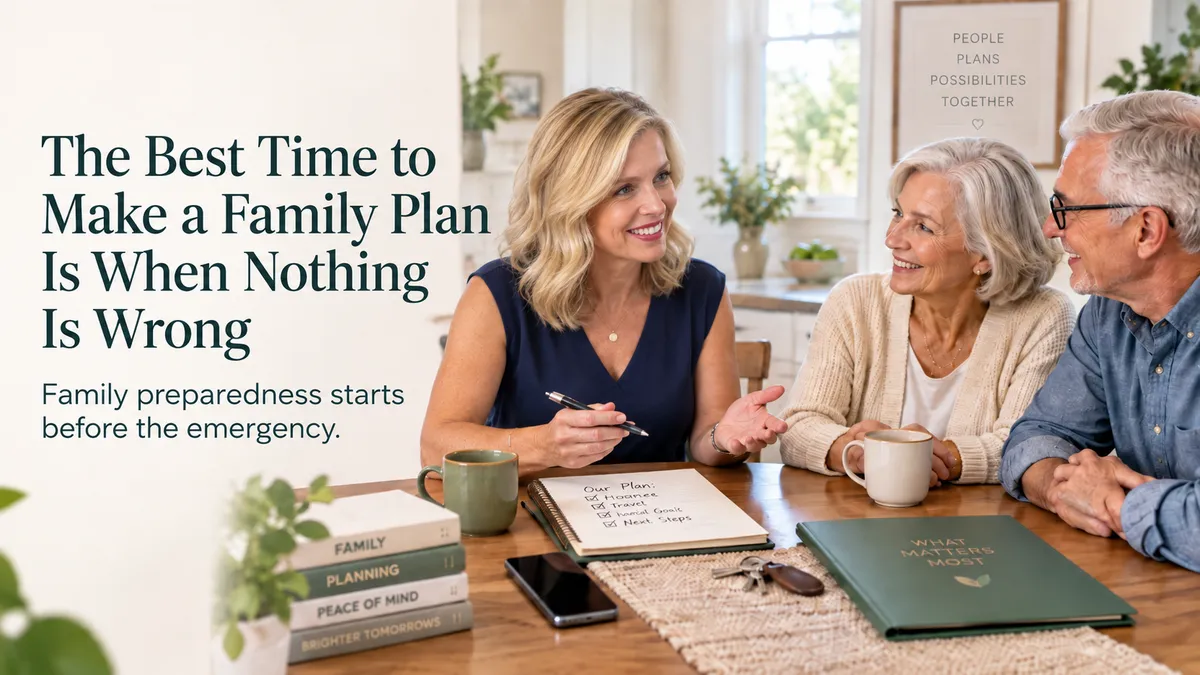
The Best Time to Make a Family Plan Is When Nothing Is Wrong
Most families wait for a reason before they start having conversations.
A fall. A hospital stay. A scary diagnosis. A missed medication. A sudden phone call from a neighbor.
Then everybody freaks out and scrambles.
Who has the keys? What medications does Dad take? Where are the legal documents? Which hospital does Mom use? Does anyone know the alarm code? Who is supposed to call the doctor? Which sibling is handling what?
The problem is not that families do not care. The problem is that when everything is fine, it feels unnecessary to prepare.
Mom is still driving.
Dad is still mowing the lawn.
They are paying their own bills, making their own appointments and living their own lives.
So everybody keeps going.
Until suddenly, the information you never thought you needed becomes the information you need immediately and that is why the best time to make a family plan is when nothing is wrong.
Preparedness is not pessimism
A lot of people avoid these conversations because they feel heavy.
Talking about medications, legal documents, emergency contacts or future plans can feel like you are expecting something bad to happen.
But that is not what family preparedness is.
It is the same reason you carry insurance, save an emergency contact in your phone or know where the fire extinguisher is. You hope you never need it, but if you do, you are very glad somebody thought ahead.
And family preparedness does not have to mean sitting around the kitchen table having one giant, uncomfortable conversation about death. It can start with something much simpler.
“Hey, if something happened and I needed to get into your house, where is the spare key?”
“Can you show me where you keep your medication list?”
“Who is your primary doctor again?”
“Do you have your important documents somewhere easy to find?”
One question. One answer. One less thing your family has to figure out under pressure.
The real cost of waiting
When families are unprepared the burden does not disappear, it becomes an (expensive!) emergency.
Adult children miss work. Flights get booked at the last minute. Grandkids’ schedules get rearranged. Siblings start arguing about who knew what and who was supposed to handle what.
People make decisions with incomplete information while they are scared, tired and emotional. And sometimes the hardest part is not even the emergency itself, it is realizing afterward that there were things you could have already asked, said, and done.
I know that feeling personally.
Before my parents died, there were conversations I avoided because I did not want to think about a future without them. My dad told me they had finished their will, and instead of asking him to walk me through it, I said, “LA LA LA! I don’t want to think about it!”
Because knowing would’ve made me envision a life without them.
I understand now that avoiding the conversation did NOT change the outcome. It just left us an even bigger mess to try and figure out after they were gone.
That is one of the biggest reasons I do this work now. Not because families should spend their lives preparing for the worst, it’s the opposite! I want families to spend less time worrying because they already know the basics.
You do not need to know everything
This is where people get overwhelmed.
They picture a giant binder, dozens of legal documents, a three-hour family meeting, and a complete plan for every possible future scenario.
Not that it’s a bad thing but the overwhelming thought of it makes us avoid it completely. But you can start smaller. It’s a lot of the little things that can make a huge difference in case of an emergency.
If your parents are still independent and doing well, this week find out just five things:
What medications are they taking?
How would you get into their home if they could not answer the door?
Where are their most important documents?
Who are their primary doctors and emergency contacts?
Who in the family would take the lead if something happened?
If you already know all 5, then you are more prepared than many families. But if you got halfway through that list and thought, “I actually have no idea,” that does not mean you need to panic, it means you found your starting point.
Prepared families protect everyone’s freedom
This is the part people often miss. Family preparedness is not about taking control away from your parents. It is not about assuming they cannot handle their lives and it is not about turning yourself into their full-time caretaker. Having conversations early and being prepared protects independence. Your parents get to keep living their lives. You get to keep living yours. You are simply making sure that if something changes, your family is not starting from zero.
That might mean having the right phone numbers.
Knowing where things are.
Making a few home safety improvements.
Clarifying who is responsible for what.
And having conversations now, while everybody is calm enough to actually hear each other. The goal is not to build your life around an emergency that may never happen, the goal is to make sure an emergency does not cause chaos and completely take over your life if it does.
One question this week
If your parents are doing well today, good. That is exactly when to start.
Do not wait for a crisis to give you permission. Ask ONE question this week.
You might be surprised how much peace of mind comes from simply knowing a little more than you knew yesterday.
That is family preparedness and the best time to start is while life is still normal.
Want a simple place to start? Take the Family Preparedness Scorecard and see where your family has gaps before they become emergencies.
