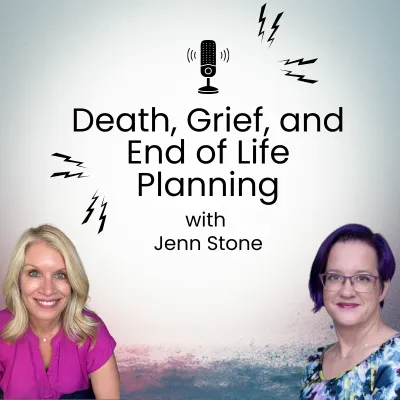
Death, Grief, and End-of-Life Planning for Families
We spend most of our lives trying not to think about death. We avoid the conversations, change the subject, and tell ourselves, “We’ll deal with that later.”
But “later” eventually shows up. For me, it showed up with both of my parents. For my friend Jenn, it showed up with her grandmother, her bonus mom, and now her dad. And out of those experiences, she discovered a calling most of us never think about: becoming an end-of-life doula.
This blog comes from a conversation I had with Jenn Stone, founder and CEO of Finishing Well at EOL. She’s doing incredibly important work around end-of-life, grief, and proactive planning and I want you to hear her story, because it directly impacts how we live the second half of our lives.
What Is an End-of-Life Doula?
Jenn is an end-of-life doula, which means she supports patients, families, and caregivers as someone approaches the end of life. Think of her as:
A guide through the emotional, spiritual, and practical parts of dying
A translator between the medical world and the family
A calm, grounded presence in the middle of chaos
She’s honest: so far, most of her “clients” have been family, and a lot of her work has been education—hosting Death Cafes, starting grief groups, and helping people understand what really happens at the end of life.
One of the biggest things she wants people to know?
Hospice is wonderful, but it’s limited.
In many situations, hospice might send:
A nurse for about one hour a week, and
A CNA for a few short visits for bathing
The other 160+ hours? That falls on the family. And if you’ve never done this before (most people haven’t), it’s overwhelming, confusing, and emotionally exhausting. That’s where a doula can step in and help.
Death Cafés: Why We Need to Talk About Death
One of the ways Jenn started doing this work is through Death Cafés—informal gatherings where people sit together and talk openly about death:
Not a grief support group
Not a therapy session
Just a safe space to talk about death, dying, and how it’s affected us
The whole movement started in Europe and now has a global presence through deathcafe.com. People come with their questions, fears, and stories, and leave feeling less alone and less “weird” for thinking about these things.
Jenn’s belief—and I agree with her—is this:
Talking about death helps us live more intentionally now.
When we remember that our time is limited, we plan better, love harder, and stop postponing the conversations and decisions that matter.
Life Support: A Sacred Space for Grief and Growth
Jenn also created a grief support group called “Life Support: A Sacred Space for Grief and Growth.”
Here’s what makes it different:
The first 45 minutes are a sharing circle.
Any type of grief is welcome:
Loss of a person
Loss of a pet
Loss of a job, relationship, identity, or faith
After that, they move their bodies—to shift the energy and help regulate the nervous system.
Then they do a “celebrating life” activity, like:
Art therapy
Somatic movement
Hypnotherapy sessions led by guest practitioners
One attendee recently told Jenn she got more relief from one session of Life Support than she had from six months with her counselor—and it gave her the clarity to seek a better fit for therapy. That’s the power of being in the right room, with the right people, talking about the right things.
It’s not in a church, it’s not tied to hospice, and there’s no barrier to entry beyond walking through the door. It’s grief support for real people in real life.
Jenn’s Story: Caring for Her Grandma at the End of Life
Jenn’s path to this work wasn’t planned—it was a series of breadcrumbs.
During COVID, her uncle called and said: “Grandma can’t live alone anymore. We need to move her into a facility.” Jenn’s immediate response was:
“No. If she goes into a facility right now, we may never see her alive again.”
So she stepped in.
Her grandmother was 92, living with dementia, and Jenn became her full-time caregiver for the final 13 months of her life. She moved in, learned the hard way how to navigate dementia, called the 24/7 Alzheimer’s hotline when she didn’t know what to do, and joined online caregiver groups just to feel less alone.
Hospice helped—but there was still a huge gap. Most of it fell on Jenn’s shoulders.
When her grandmother finally took her last breath, Jenn was sitting beside her, eating dinner. That detail matters, because during that season, stress had killed her appetite and she’d unintentionally lost about 30 pounds. That night, she was hungry. She stayed, finished her meal, prayed over her grandmother, played music, and gave herself time to honor the moment before calling anyone.
She remembers feeling:
Deep relief that her grandmother was no longer suffering
Deep peace in being there for that final moment
And a powerful awareness that dementia is brutal—not just for the person living it, but for everyone who loves them
That experience planted the seed: “Families shouldn’t have to figure this out alone.”
Her Dad’s Story: What Happens When We Don’t Plan
Later, Jenn’s father began declining—physically and cognitively. Unlike her grandmother, he:
Retired early
Stopped riding his Harley when his body couldn’t handle it
Spent most of his time in his man cave watching TV
His body declined. His mind declined. And he refused to talk about the future.
He didn’t make plans. He didn’t want to discuss end-of-life decisions. He didn’t set things up clearly. Now Jenn and her sister are dealing with:
Mountains of paperwork
Trying to figure out accounts, assets, and logistics
The likelihood that his house will go into probate
The “million little heartbreaks” of watching him decline in assisted living, needing help with basic things like paying for breakfast
And here’s a critical point Jenn made:
Dementia is not a normal or inevitable part of aging.
It’s a disease process—not something we just have to accept as “what happens when you get old.”
We can’t control everything—but we can:
Take better care of ourselves in midlife
Be proactive about our homes, health, and legal documents
Have the hard conversations before we’re forced into crisis mode
What an End-of-Life Doula Actually Does for Families
So what does a doula like Jenn actually do?
Here are a few of the roles she described and implied in our conversation:
Calm the chaos
When a loved one is dying, even the most capable people feel overwhelmed. A doula helps families slow down, breathe, and navigate decisions without panic.Hold space for the hard emotions
Everyone is hurting—but often nobody wants to burden each other. A doula becomes a safe place to:Vent
Ask “Is this normal?”
Admit the thoughts you don’t want to say out loud to your family
Translate and observe
Doulas are trained in the most common end-of-life disease processes and comfort interventions. They know what’s normal, what isn’t, and when to speak up on behalf of the family or patient.Protect the caregiver’s energy
Jenn actively encourages family caregivers to stop doing everything and delegate what they can:Grocery shopping
Dog walking
House tasks
Why? So they can just be the daughter/son/partner again, not the exhausted project manager of their loved one’s final chapter.
How This Connects to Proactive Aging (and Your Parent Porter)
This is where Jenn’s work overlaps with mine.
She’s walking with families at the end of life. I’m working with families who still have time to shape what that end looks like.
In our conversation, we talked about:
How most of us avoided thinking about death until our parents got sick or started declining
How watching our parents age can be a wake-up call for our own second half of life
How much easier things would be if we:
Talked about wishes early
Made a plan for the home, the finances, the care
Took care of our own health now, not “someday”
Right now, the average life expectancy is somewhere in the high 70s. That means if you’re around 40–50, you’re midlife. You’re not “too early” to have these conversations, you’re right on time.
That’s exactly why I created Your Parent Porter: to help families take a proactive approach to aging in place before a crisis forces everyone into reactive mode.
Simple Ways to Start the Conversation (Even If It Feels Awkward)
If you’re reading this and thinking, “Okay, but how do I even bring this up with my parents?” you’re not alone.
Here are a few softer ways to open the door:
“Mom, Dad, I just listened to a conversation about end-of-life doulas and planning. It made me realize I have no idea what you’d want if something happened. Can we talk about it sometime soon?”
“If there was ever a time when you needed more help at home, what would feeling ‘respected and in control’ look like for you?”
“I’m trying to be more proactive about my own future. Would you be open to doing some planning together so we’re not scrambling later?”
It will never feel like the “perfect” time. As Jenn said, there is no ideal moment when everyone’s ready, calm, and excited to talk about death. You do it anyway—because not talking about it leads to confusion, conflict, and a lot of unnecessary pain.
Where to Find Jenn & How We Can Support You
If you or someone you love is navigating grief, end-of-life, or just wants to learn more about what a doula does, you can find Jenn Stone on Facebook and Instagram.
And if you’re ready to take a proactive approach to your parents’ independence, or your own future, this is exactly the work I do through Your Parent Porter:
SAFE home & wellness check-ins
Proactive aging-in-place planning
Helping families have the conversations they’ve been avoiding
Turning worry into a plan and “someday” into “handled”
Final Thought
Tomorrow isn’t promised, but today is in your hands.
You don’t have to obsess about death—but you do need to acknowledge it, plan for it, and then get back to living fully: happy, healthy, and, hopefully, safely at home for as long as possible.
If this stirred something in you, that’s your nudge.
Start the conversation. Make the plan. Take the steps.
And you don’t have to do any of it alone.
Here is the full interview on YouTube @yourparentporter
